


Global LCD LCD panel price rise fierce, 55 inch LCD panel rose 70%!
2021.01.06
Global LCD panel prices are rising unusually. Liquid crystal panels are in short supply worldwide. This is due to the COVID-19 outbreak, the expansion of home office and online education, the increasing demand for personal computers, and the stay-at-home lifestyle, which has strengthened TV sales. In terms of panel prices, computer products have increased by 20 percent compared with the spring before and after, and TV products have increased by 60 percent. There have been "unprecedented price increases" (analysts in Japan).
"Can not buy the panel, production can not keep up with. Can only ask some customers to delay the delivery time". So says the head of procurement at a domestic computer maker.
According to data from IDC, a RESEARCH company in the United States, the global PC supply from July to September 2020 reached 81.3 million units, with a year-on-year increase of 15%. As the COVID-19 continues, "there has been a trend for previously rented people to buy computers for home office use around spring" (an electronic parts trading company). There has also been a rush to buy computers for online education around the world.
In Japan, it also caught up with the special needs brought by the idea of "GIGA Schools", which would give all primary and secondary school students access to learning terminals such as personal computers. In April the government brought forward a plan to equip every primary and secondary school student with a computer from 2023 to 2020. Japan has about 9.5 million children and students nationwide, roughly the same number as the country's domestic computer supply in 2019 (about 9.73 million units), but "delivery dates could be pushed back to 2021" (a trading company for instructional computers).
Television sales are also showing good momentum. With people having trouble getting out, there is a huge demand for watching videos and playing games on big screens at home. Global TV sales rose 15 per cent year on year to 62.87 million units in the july-September period, according to Omdia, a UK research firm.
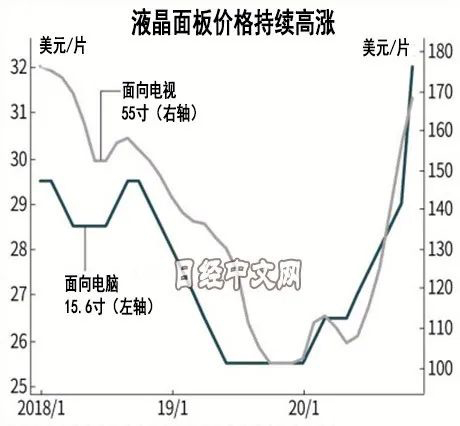
The result has been a shortage of panels and higher prices for computer and TELEVISION manufacturers. At block prices in November, the 15.6-inch HD laptop is up about $3 (10%) from the previous month, at about $32 per panel. About 20 percent higher than before COVID-19. The number of 55-inch TVS is up 8 percent from the previous month, at around $168 each. That's about 60 percent higher than the lowest point in spring.
The supply of LIQUID crystal panels seems unable to keep up with demand. While Chinese companies such as BOE have been increasing production of LCD panels in recent years, some large companies have shifted their focus of investment away from LCDS to other panels, such as South Korea's LG Display, which has increased production of OLED panels. At present the investment heat of liquid crystal panel has been reduced.
But with the COVID-19 outbreak, computers and televisions are selling fast, and demand for LCD panels is soaring. LG Display announced in January 2020 that it would suspend domestic production of LCD panels for televisions in 2020. But as the market recovers, the company intends to continue production for a short time. Sales at Hon Hai's LCD panel unit, Innolux, rose 21 per cent in November from a year earlier. Peer AUO also added 22 per cent.
"With the use of money still flowing into home appliances due to external suisu and restrictions, demand for TVS and computers is expected to remain high in the first half of 2021," said Kiyoko Tamura, Asia director for DSCC, a US research firm. Televisions and computers drive current consumption, but if production is delayed by a shortage of panels, it could hamper the world's economic recovery and the development of new lifestyles such as digitisation.
Mr Tamura said there was also the issue of "rising panel prices not being passed on to the final product now on sale". LCD TV prices are on a downward trend at home appliance stores, but some new products from 2021 May make consumers less willing to buy.
LCD rammer's 55-inch price rises 70% a year! Industry: Growth continues through Q1
As people stay home to watch TV and play video games, demand for panels has soared, with prices for liquid crystal display (LCD) screens soaring 70 percent this year. With the epidemic still severe in Europe and the United States, industry insiders expect LCD's rally to continue at least until the first quarter of next year.
Etnews, GizmoChina reported that Omdia's data showed a 55-inch UHD TV panel for a November price of $170. The offer is up 70 percent from $100 a year earlier. Not only that, the 65-inch LCD panel also sold well and has been quoted above $200 for two consecutive months. The price has risen by another $15 since last month.
Consumers usually prefer the better painted UHD panels (pixel 3,840×2,160), but this craze has seen even Full HD (pixel 1,920×1,080) turn into a hit. The 43-inch Full HD LCD panel topped $100 for the first time this year. The price of a 32-inch HD LCD panel stands at $61, a recent high.
More and more consumers buy small - and medium-sized TV, to play video, watching network movies. At the same time, people are buying TV sets to make it easier for each family member to watch different channels. Industry representatives said the price of LCD TV panels will rise until at least the first quarter of next year as demand for TVS surges during the outbreak.
At present, the factory took the LCD market share. Liang Xinqing, secretary-general of the LCD branch of the China Optical And Optoelectronics Industry Association, estimates that China will account for 55 per cent of global panel shipments by 2020. In the first three quarters of this year, he estimated global display output at $82.723 billion, up 8.6 percent from a year earlier. Shipments rose 5.7 percent to 178 million square meters.
This round of LCD panel price rise is not a healthy market cycle, but an unexpected epidemic effect
Chatter away! LCD prices under the display industry picture. TCL Huaxing T7 project was lit in advance, Huike Changsha line exposure machine of generation 8.6 was moved in advance, Rainbow 2.2 billion yuan was increased production capacity of Generation 8.6 line, LG and Samsung planned to close the LCD panel line at the beginning of this year, and all production was resumed... Since the second quarter of 2020, the global LCD industry is "a boom", and at the same time, the price of LCD panels is rising endlessly!
How much did the LCD panel go up
Price trends for LCD panels in October and November
To rise in price this matter, big screen gentleman reminds everybody all the more, want to have a structural "view" : namely, 55 inches and below dimension, original product price is low, 618 market 55 inches TV falls to 1500-1800 yuan price, 42 inches fall below 1000 yuan. Therefore, the price of this kind of product panel increases by several tens of dollars, which has a very significant impact on the product terminal price.
Compared, high-end products, in which more than 65 inches products, "dimension model is at a premium, corporate profits than too high", which makes the panels are relatively lower proportion of color TV inherent cost, its products affected by the upper panel price fluctuations smaller - so, double tenth of a market, offline TV this is given priority to with large consumption of scene, product price rose only 7%. In particular, prices for products 75 inches and above continue to rise, but prices for end-products continue to slide (the process of eliminating large size profits continues).
Sales of color TVS above 70 inches doubled and the market share of products 55 inches or less fell nearly 20 percent during the singles' Day holiday, as large-size LCD TVS became cheaper than ever but prices for smaller sets rose sharply. Although big screen jun does not think that the price increase of small and medium size is the main reason for consumers to choose large size products more, but "unbalanced terminal price fluctuation" does have a certain impact on the ratio of color TV consumption market structure.
Why is the price of LIQUID crystal panel suddenly surging
The reason for the rise is no other than "supply and demand imbalance". However, under the COVID-19 epidemic in 2020, how could there be a sudden imbalance in supply? Many industry analysts say it is a "cyclical factor", but Daping jun doesn't think so.
From the perspective of cycle, it is the real periodic law that Samsung and LG of South Korea propose and implement a comprehensive LCD panel production capacity withdrawal plan at the end of 2019 and early 2020. Because, in the previous mainland manufacturers high-speed expansion of the background, the industry believes that at least the LCD panel will enter as long as more than 3 years of surplus period. As a relatively high cost of Korean enterprises, exit the market is "less loss"!
However, Samsung LG's latest position is: production of discontinued lines quickly resume, sold half of the old equipment no longer sell! The industry's deleveraging cycle has been brought to an abrupt end: the reason is that demand for colour televisions in Europe and the US "keeps going up". Big screen gentleman looks up such data, 3 quarters of this year increase 20 %, recapture the name of the world's largest color TV market. Europe, while not doing as well as America, has kept consumption strong. In fact, PC and NB LIQUID crystal panels have ended the continuous decline in the past five years, and actually formed a rapid growth in the past half year. The global PC market shipped 79.2 million units in the third quarter of 2020, with a year-on-year growth of 12.7% and the highest growth rate in the past decade.
What is the "sudden change" in the demand market? First, Europe and the United States have adopted loose monetary policies and the Federal Reserve has resumed QE without limit, injecting too much liquidity into the market. Although the epidemic prevention and control in developed countries is in a complete mess, the market is really not short of money. What's more, the US directly subsidizes the cost of living for families and prints money without a problem (as a global currency, the dollar is creating an inflationary spillover effect in global markets, with seignifiage and reaper effects in the global economy). These measures show that the US consumer market is far more active than "expected".
Second, it is certainly not a good choice to "go out" in the face of the epidemic. As the epidemic in Europe and the US continues to surge, it is bound to be of great help to the development of the housing economy, housing office and housing education market. In fact, since the second quarter, not only color TV sets, PC and NB products, but also other residential economic products have been very active in the European and Us markets. In fact, China's exports of tractors doubled in the third quarter (influenced by the agricultural subsidies in Europe and The United States under the loose monetary policy). The use of loose monetary policy to reserve certain materials and demand more domestic economic materials has become a trend of consumption in Europe and the United States!
These two factors have led to the fact that the display products represented by color TV sets in developed countries and even some developing countries are not shrinking, but expanding. The expansion beyond imagination caused Samsung LG's production suspension plan to die "unexpectedly", and contributed to the shortage of supply and price rise. Especially considering that color TV sales above 65 inches are up about 50% so far this year, and demand for items 55 inches or less has fallen sharply -- "small for big" will also consume more panel capacity, since a 65-inch TV has more panel area than four 32-inch TVS.
Therefore, this round of price increase is mainly due to: 1. The demand boost of Europe and America exceeding expectations and the epidemic situation, and the promotion effect of QE and homebound economy; 2. And 2. Panel consumption is accelerated by the popularization of large size acceleration. Among them, the former plays a major role. As for many of the analysis's so-called "cyclical factors", namely the capacity cuts at LG and Samsung, this is the weakest factor.
Talk of price increases, until when
LCD panel seven or eight months, 2 to 60 percent of the price rise, this kind of thing in the history of the panel industry are rare!" At the same time, more need to realize that this round of price increases do not conform to the "general panel industry growth cycle rule." Just because of these two points, big screen jun thinks "the price increase is not sustainable"!
First of all, QE and homebound economies in Europe and the US are both products of the "coronavirus association" and cannot "become a long-term state". In particular, America's direct cash subsidies are a short-term emergency. This determines that the most central driver of the rally must exit at some point: when the vaccine matures, for example, or when the new crown naturally disappears.
Secondly, in terms of the development of large size, it is a long-term trend of positive panel industry. However, how fast the market for large size products expands is directly proportional to the rate of price decline: now the price rise in the heyday, it is inevitable to let the speed of large size popularity decline. This helps ease the pressure on the supply side of the industry.
Third, the production of LG and Samsung's LIQUID crystal lines has been turned into a resumption of work, and many domestic LIQUID crystal panel lines are also accelerating the construction and production capacity release. In the context of the intensified supply side, the continuous "supply shortage and price rise" situation is unlikely to occur.
As a result of these three points, big screen jun thinks, price stabilizes inevitable to become the fundamental trend of future period of time liquid crystal panel. Especially after the peak season of The Spring Festival in 2021, it is likely that the spring of 2021 will be the last moment of panel price increase. After that, whether prices remain volatile or fall depends on the ratio of "demand to supply", which Mr Wang has more to say about:
In short, Daping jun believes that this round of LCD panel price offensive is not a healthy market cycle factor, but an unexpected epidemic effect, with sudden, unsustainable, and a certain overdraft market benefits. Of course, the price of the wind, manufacturers should seize the opportunity to harvest a wave: only this round of harvest more, there are more resources to deal with the future of uncertainty, and even further supply relative surplus.