


Analysis of the Global TFT LCD and Large-Size LCD Panel Industries from 2020 to 2025
2020.10.23Analysis of global TFT LCD shipments from 2020 to 2025.
Global shipments of small - and medium-size TFT LCDS are estimated at 1.81 billion in 2020, down 19.7 percent from 2019, due to the coVID-19 epidemic, DIGITIMES Research observed. Although the demand for smart phone panels is expected to recover in 2021, the acceleration of the upsizing of the mainstream size of tablet computers, the continuous shrinking demand for digital cameras, and the continuous shift of smart phone panels to AMOLED will make the automotive and Internet of Things (IoT) applications become the main growth drivers for the shipment of small and medium-sized TFT LCD starting from 2022.Overall, DIGITIMES Research estimates global shipments of small - and medium-size TFT LCDS will hold steady at just 1.82 billion units by 2025.
In terms of the largest number of mobile phone applications, although the demand for panels dropped sharply in 2020 due to coVID-19 epidemic, with the end of the epidemic, it is estimated that the market demand will recover in 2021. The CAGR of mobile phone panel shipments from 2020 to 2025 is estimated to be 3.1%, among which smartphone applications will reach 5.9%.The penetration rate of AMOLED panels in smart phones will reach 40% by 2023, squeezing the TFT LCD space. It is estimated that the CAGR of global TFT LCD shipments used in mobile phones will be -0.8% from 2020 to 2025.
The new 6 generation AMOLED lines introduced for mass production in China in 2018~2022 include 4 from BOE, 2 from Tianma and Versino respectively, and Wuhan Huaxing Factory, which shows that The investment of Chinese enterprises in small and medium-sized panels is also shifting from TFT LCD to AMOLED.
Due to the high threshold of AMOLED technology, it takes about 1 to 2 years from mass production to yield and cost to compete with LTPS TFT LCD. Therefore, at present, the domestic LTPS TFT LCD production line can still maintain its competitive advantage, especially the Tianma Xiamen Line 6, which has a relatively competitive advantage due to its early mass production time and high yield. BOE's 6 AMOLED production line is the earliest among domestic manufacturers in mass production. However, it has been cooperating with Huawei for a long time and Huawei has been subject to sanctions from the United States, which inevitably affects BOE's AMOLED development. In 2019, Huaxing Wuhan expanded production of 6GEN LTPS TFT LCD from 30,000 glass panels per month to 50,000, making it the only local enterprise capable of expanding LTPS TFT LCD production among most local enterprises that have turned to AMOLED. Its Wuhan 6GEN AMOLED production line has also completed mass production.
Note the rise of automotive and IoT applications.
In mobile phones, tablet computer and digital camera, handheld games, portable navigator (PND unit), MP3 players and other portable consumer electronic products market gradually mature into recession, even includes industrial control, automotive and intelligent speakers, smart IoT applications, such as white goods will shipment into small and medium size panel new growth impetus, DIGITIMES Research forecasts, this kind of application of small and medium size TFT LCD shipments in 2020 ~ 2025 CAGR of 6.1%.
Global large-size LCD panel industry and market development from 2020 to 2025
DIGITIMES Research envisages global industry and market development of large-size LCD panels (9 inches diagonally or above) by 2025. Scenarios with annual capacity growth above 9.4% in 2018-2019 will no longer occur and overall supply and demand will be healthy. In terms of supply, BOE and TCL Huaxing, the two domestic giants, are expected to control nearly 49% of the production capacity in 2025, and will dominate the market trend.
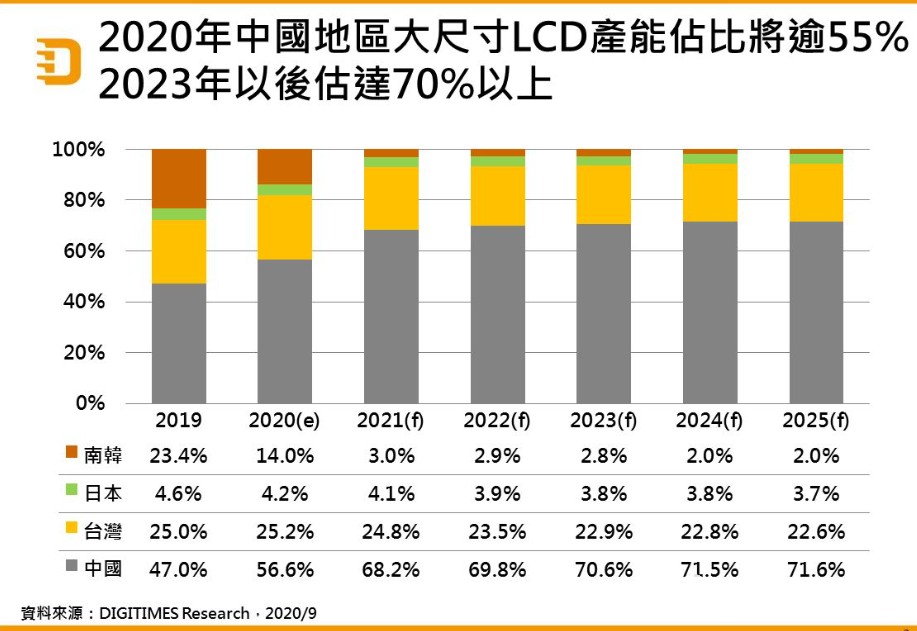
As South Korean companies scale back LCD production in South Korea, Samsung Display; SDC's 8.5 OEM factory in Suzhou has also been transferred to TCL Technology. It is estimated that SDC will continue to focus on small and medium-sized AMOLED and expand its investment in new quantum dot (QD) OLED panel products. Domestic panel manufacturers BOE GFS and TCL Huaxing continue to expand the panel production capacity of 10.5/11 generation, and are expected to complete the equity acquisition of CPT Panda 8.5/8.6 generation plant in Nanjing and Chengdu and SDC Suzhou 8.5 generation plant respectively within 2021. The combined production capacity of these two panel manufacturers is expected to reach a nearly doubling influence from 24.5% in 2019 to 2025.
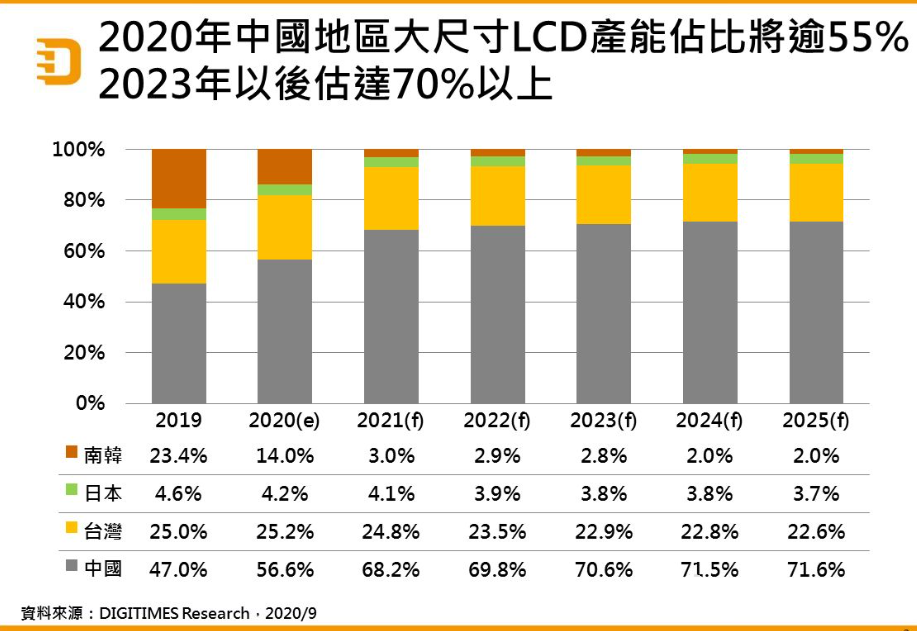
Since 2019, China has become the largest producer of large-size LCD in the world (including LCD factories set up by South Korean manufacturers).China's large-size LCD production capacity will account for 56.6% in 2020 and 68.2% in 2021.
The top five players in terms of share of large-size LCD capacity in 2020 and 2025 will be BOE (20.9 percent), Qunchuang (13.9 percent), LG Display(12.0 percent), TCL Technology /TCL Huaxing (11.8 percent) and YAU Da (11.3 percent) in order in 2020.By 2025, the top five companies are BOE (30.0%), TCL Technology /TCL Huaxing (18.8%), Qunchuang (12.5%), Huike (11.7%) and Au (10.1%), in order.
What's the logic behind LCD price rises? The key factor lies in the imbalance between supply and demand.
LCD prices have been rising for four months because of your home gaming? Since this year, the whole LCD market smoke. Whether the LCD market price rises for four months after the epidemic, or the panel giants in Japan and South Korea sell their production lines one after another, or the Chinese mainland listed companies frequently integrate acquisition, investment and build factories, all make the industry full of interesting points.
The logic behind LCD price rises?
LCD price rises are a foregone conclusion. Since May this year, LCD prices have risen for four months in a row, making the whole industry chain dynamic. Why is LCD rising in a volatile 2020? The key factor is the imbalance of supply and demand structure.
1. The epidemic has stimulated consumer demand, with LCD TV panel rising the most.
According to market observation (Table 1), in terms of product types, low-end LCD products have seen a large increase, about 20%-30% or even 40%-50%.In particular, the average price of a LCD screen for a small 32-inch TV hit $45 in August and was up $5 in September. The 43 inches and 55 inches rose more than double digits in August, reaching 13.7% each, and rose another $7 and $13, respectively, to $91 and $149, respectively, in September. For larger sizes, overseas stocks remained strong, with prices for 65 inches and 75 inches rising $10 on average to $200 and $305 respectively in September. The price of LCDS for large-size TVS of 70 inches or more hasn't budged much. In addition, LTPS screens and AMOLED screens used in high-end phones have seen little or no increase in price.
In October, LCD price increases are expected to moderate. The data shows that in October 32 inches or 2 dollars; Gains of 39.5 to 43 inches will shrink to $3.55 inches will fall back below $10; the 65-inch gain will narrow to $5.
"The price of LCD TV panels continues to rise, which has a lot to do with the epidemic," a spokesman for a major domestic LCD manufacturer told Business News international. During the epidemic, people stayed at home and had no way to go out for entertainment. They relied on TV sets, PCS and game consoles for entertainment. After the resumption of work and production in mainland China, the traditional home appliance market has recovered rapidly, and LCD production capacity has been rapidly digested. Televisions alone consume over 80% OF LCD production capacity. However, due to the shutdown and shutdown of most factories lasting 1-2 months during the epidemic period, LCD production capacity was limited, leading to insufficient capacity to cope with the market outbreak, which eventually led to the market shortage and price increase for 4 consecutive months. She said the factory is currently operating at full capacity.
"But I think, with the improvement of technology and the promotion of the 8K HD TV and e-sports market, the TV size will develop towards the larger screen, which will better meet the entertainment needs of end consumers. In addition, the fight against the epidemic will be a long-term and rebounding process. The housing economy will continue to develop, and the end consumer market is expected to consume more panel production capacity. The spokesman expressed optimism.
2. The industrial development correction started to brew at the end of last year.
In fact, the last round of LCD price rise cycle was from 2016 to 2017. Since 2018, the overall market price has continued to fall, and even in 2019, some types have dropped below the cost of materials, and the whole industry has experienced a general operating loss. Since last year, LCD makers have been looking to improve margins.
Returning to a reasonable price range was the most talked about topic among panel makers last year, a source said. Some manufacturers for the serious loss of the product made the decision to reduce production or even stop production; some manufacturers planned to raise the price, but due to the epidemic, downstream demand was temporarily suppressed, the price was postponed. After the outbreak was brought under control in April, the country resumed production and the price of LCD screens began to rise in mid-late May.
A spokesman for the above-mentioned Chinese LCD manufacturer also said that his company had already predicted this wave of price increases at the beginning of this year, and speculated that it would continue until at least the end of this year.
"This kind of price correction is in line with the laws of industry development," said another. "You can't 'let the horse run and not let the horse eat the grass'. Having reasonable profit margins will stimulate the whole industry to move forward."
Of course, building factories and expanding production cannot be accomplished overnight. There will be several price fluctuations predicted during the process of capacity recovery, and the possibility of passing on costs to downstream vendors or consumers in the event of major price increases requires continuous attention,' the spokesperson told Ecic.
Teenager, development of domestic LCD depends on you to play "esports"!
As millennials become a major force in China's economic cycle, their beloved entertainment market is on the rise. For LCD manufacturers, esports economy will be the next market driver.
In 2019, "e-sports player" became a new profession officially recognized by the government, and China e-sports club won the global championship of League of Legends S9 again. The government, capital and brand invested more and more in this period. Despite the impact of the epidemic on the development of e-sports industry at the beginning of 2020, live-streaming and stay-at-home economy have opened another window for the industry. In August, Beijing launched the "Esports Beijing 2020" campaign, and even launched the "5G Cloud Esports Industry Alliance" combined with the new generation of communication technology to incubate and promote local esports projects.
Benefiting from this, esPORTS LCD shipments did not decrease under the epidemic. BOE data shows that BOE Q1 LCD commercial market demand declined, but the LCD panel with a wide perspective and locked in the e-sports market increased steadily.
At the same time, at present, there are many local panel manufacturers deeply into the FIELD of ESPORTS LCD, not only to provide the panel, the overall solution, but also support customized services. Take ESPORTS displays for example, since 2016, mainstream display brands have successively released a large number of esports (sub-brands), such as ASUS ROG esports, ACER ACER launched the Predator, Hui Ke HKC launched the Ant Esports, BenQ's ZOWIE esports, AOC launched the Esports, and so on.
"These days, esports products are sold at high prices, and young people are willing to pay for games and game accessories. So whether it's 2B or 2C, esPORTS screens will be a battleground for local panel makers!" said the spokesperson.